
2009 Berry Street Essay: The Reverend Paul Rasor
Ironic Provincialism
189th Berry Street Essay
Delivered by Reverend Paul Rasor
Salt Lake City, UT
June 24, 2009
Paul Rasor, Director, Center for the Study of Religious Freedom and Professor of Interdisciplinary Studies Virginia Wesleyan College
Does it sometimes seem that Unitarian Universalists are always in themiddle of an identity crisis? That at some level, we are forevertrying to figure out who we are?
Liberalism will do this to you. Our commitment to religious freedom, our openness to new ideas, our insistence that religion should live in the present and not in the past, our healthy theological pluralism– all of these, the very things that make us liberal, mean that our collective religious identity will inevitably be difficult to pin down at any particular moment in our history. Dean Lewis Fisher captured this reality nearly a century ago as he anticipated the question of where Universalists stand. “The only true answer,” he famously said, “is that we do not stand at all; we move.”1 The same could have been said for Unitarians, of course, and this remains true for Unitarian Universalists today. We seem to be afflicted with a kind of theological ADD. I recognize this, because I also struggle with this annoying affliction.
Our peripatetic progressivism means that we are often ahead of the cultural curve in responding to the realities of the world around us. Yet there are times when the opposite is true, when the realities are so daunting that we freeze up, playing out Dean Fisher’s aphorism in reverse: we do not move; we stand. Not to be overly dramatic, I believe we face a major turning point in Unitarian Universalism, and our decision whether to stand or move will shape the identity and set the course of our religious movement for the twenty-first century. In a word, our turning point can be summed up in the term multiculturalism.
The context of our challenge is familiar but worth saying. Our society is right now, in our generation, undergoing the most radical demographic shift in its history. We see this every day in our cities and towns, in our neighborhoods and schools and workplaces, and in our congregations. These changes are forcing us to reexamine everything we thought we knew about ourselves, both as a society and as a religious movement. Being good liberals, we have been engaged in wrenching self-examination for several years now, at least since the 1992 General Assembly Resolution on Racial and Cultural Diversity, and long before that in many ways. A glance at the lineup of workshops at this year’s General Assembly reminds us that this important work continues. I am not going to talk about these programmatic aspects of our work; others can do this far better than I. Instead, I want to place this demographic shift in a Unitarian Universalist context and then explore some of its theological implications.
While we are bound to disagree at several points, I think most of us share a general sense about where we now stand, and about the basic direction we want to move. Just to be clear, my own view is that we need to become a genuinely multiracial and multicultural faith, both theologically and demographically. We need to do this not because it is the politically correct thing to do, or because our congregations need yet another exercise in anti-racism and cultural sensitivity training, though they might, or because we think this will attract new members, though it may. Instead, we need to make this collective journey for spiritual and theological reasons.
Becoming a multiracial-multicultural Unitarian Universalism fulfills the vision we have long held. As Mark Morrison-Reed put it, we are moved to do this because we “see the richness in human diversity and [are] excited by its possibility.”2 Given the cultural context in which we now find ourselves, this is where we are drawn by our deepest theological principles and religious values. Religious liberalism has always been marked by its ability to engage and respond to the circumstances of its own time and place. This is what has kept us intellectually credible and socially relevant.
If we fail to respond to this new multicultural reality – if we choose to stand rather than to move – we not only fail to honor this core liberal principle, we will simply become irrelevant. We could devolve into a quaint relic of a once-vital tradition, holding fast to our good liberal ideas (while continuing to bicker about them), protecting an increasingly insular identity, ironically slipping into the kind of safe and unchallenging provincialism we have always resisted.
This would be a tragedy, because we have much to offer, much to say that our world needs to hear. As I will discuss in a few minutes, in many ways we are perfectly positioned to model a dynamic and life-affirming religious multiculturalism. I sense in our movement today both an eagerness and a reluctance to embrace the changes this would require. This is understandable; change is always scary, and the inertia of deeply embedded ways of being can be hard to resist. This is the flip side of our religious ADD – we can’t sit still, but our constant fidgeting doesn’t always get us anywhere because we can’t maintain our focus on the task at hand. We liberals can be easily distracted.
The Demographics
The Changing Cultural Context
Multiculturalism is partly about demographics, so I’ll begin with some numbers that illustrate the shifting cultural context within which Unitarian Universalism must now find its place. Here is the most recent census data:

The Census Bureau currently uses six main reporting categories. The option of naming more than one was added in the 2000 census. On this table, we can see that whites make up about two-thirds of the population, Hispanics and Latinos/Latinas are about one-sixth, Blacks and African Americans are about one-eighth, and so on.
For our purposes, however, the long-term trends are more important than a snapshot of any single year. You are probably aware of the well-publicized Census Bureau projection that by 2042, just over 30years from now, whites will no longer constitute a majority of the U.S. population.3 The next table shows these projections through 2050.

Notice that whites are the only group that declines steadily over this period as a percentage of the population. Asians and Hispanics and Latinos/Latinas are growing at roughly similar rates, but the fastest growing group is those who identify as multiracial. The Census Bureau reported last month that the number of people in the “two or more” category increased by three and a half percent in one year, and some demographers believe millions more remain uncounted.4 My guess is that after the 2010 census, the projections in the bottom row will be revised upward.
The next chart might give you a better feel for how rapidly these changes are taking place.

If we assume the same rates of change continue past 2050, then sometime between 2060 and 2070 Hispanics and Latinos and Latinas will replace whites as the largest population group. Some of us will likely live to see this change, as will most of our children and grandchildren.
A major factor in this shifting cultural context is immigration. Since the Immigration and Naturalization Act of 1965, 38 million immigrants have come to the United States, and immigrants now make up one-eighth (12.5%) of the U.S. population. But more important than the numbers of immigrants is their diversity.
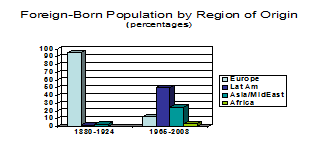
The previous peak immigration period took place around the turn of the 20th century, when 22 million people immigrated to the United States. But the racist immigration policies of that time meant that 95% of these earlier immigrants were from Europe. Today, only 13% – one-eighth – are from Europe. Half are from Latin America, a quarter are from Asia and the Middle East, and about4% are from Africa.5 Immigration has declined sharply over the past year or so, largely because of the world-wide economic situation. But the long-term effects of this immigration cycle will remain with us, including its contribution to our increasing religious pluralism.
These “new immigrants,” as they are often called, differ from earlier immigrant populations in other important ways that affect the roles they play in our new cultural reality. Just to give one example, the average educational level of immigrants other than those from Latin America is now higher than the average educational level of native-born Americans.6 The religious group with the highest education and income levels in the United States today is not Jews or Unitarian Universalists, or even Episcopalians, as you might guess, but Hindus.7
Unitarian Universalist Demographics
So how do Unitarian Universalists fit into this picture? Do we reflect the pluralistic and multicultural reality of our time, or is our brand of religious liberalism fatally linked to a culture that is disappearing? What progress have we made toward our announced goal of becoming a multiracial and multicultural faith?
To put this a bit differently: If you were asked by a colleague in another faith about the racial and ethnic diversity within Unitarian Universalism, what would you say? “Beats me,” is one possibility. Or, you might have a general impression; you might say, for example, “well, I’d guess that we’re about 90%white.” But if you wanted to verify your impression or discover how much we have changed over the past decade, where would you look? Whom would you ask? I tried to do this as I was preparing for this talk, and what I discovered is that nobody knows. We simply do not collect the data that could tell us how we are doing. When it comes to our own racial and cultural identity, our policy seems to be “don’t ask, don’t tell.” I find this both troubling and puzzling in light of our commitment seventeen years ago to create a “racially diverse and multicultural Unitarian Universalism.”8
So what’s going on here? First, I want to acknowledge that there may be some good reasons for not gathering this information. Multiculturalism is not simply about numbers. Taquiena Boston, Director of Identity-Based Ministries at the UUA, reminds us that “diversity alone is not the goal,” and that developing a genuinely multiracial and multicultural identity “must be integral to the larger mission and ministry of the congregation.”9 Or as UUA President Bill Sinkford put it, “the objective of finding a few more dark faces to make our white members feel better about themselves is not spiritually grounded.”10
And it is not just about numbers in another sense too. Unitarian Universalism has its own cultural tradition, one that is rooted in European-American cultural norms and ways of being in the world.11 This normative lens is often invisible to those of us who look through it, but it is all too visible to those who view the world through different cultural lenses. As Joseph Santos-Lyons points out, these differences mean that people of color in Unitarian Universalist congregations continue to experience isolation and lack of respect in ways that white Unitarian Universalists do not experience and often do not recognize.12 This is why our ongoing anti-racism work is so important. We cannot become a multi-cultural faith if we – subconsciously or otherwise – continue to treat a particular mono-cultural lens as normative.
Another factor is that race is a socially constructed category, one that has been used – and continues to be used – to divide human beings into artificial groups and to establish structures of privilege and oppression based on those groups. We might argue that using these categories encourages us to see each other primarily in racial terms and ends up perpetuating the social divisions we hope to overcome. Mark Morrison-Reed points to the “preposterous oversimplification of cultural and racial variations” created by the racial labels we use.13 For this reason, Bill Sinkford has commented that we need to stop saying we are a predominantly white denomination. It’s true, Bill says, but continuing to say this is not helpful. These are important considerations, and we should be mindful of them as we go forward.
Yet there are also some bad reasons for not collecting our own diversity data. One factor that often comes up in program evaluations is fear, especially fear of conflict and fear of change.14 Our “don’t ask, don’t tell” policy might simply be an avoidance mechanism, one that allows us to feel good about our workshops without having to worry about what they are actually accomplishing. Marilyn Sewell tells us that “there are some things we prefer to be misinformed about, or hazy about.” Instead of confronting hard realities that might force us to change, she says, “We would rather deal in statistics.”15 Apparently we sometimes don’t even do that.
I understand that numbers are not the whole story, that seeking diversity for its own sake is wrong-headed, that the demographics will play out differently in different congregations, and that congregations with zero diversity can still be effective anti-racist allies in their communities. But in the end, the numbers matter. If we are going to name ourselves as a multiracial-multicultural faith, the name should mean something, and part of that meaning is wrapped up in demographics.
So in the face of Marilyn Sewell’s caution, I want to give you some statistics. I’ll begin with two sets of numbers that are probably familiar.
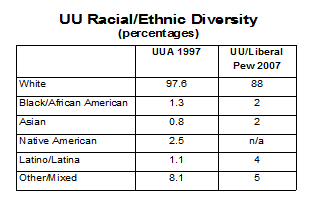
The first column is from the 1997 Fulfilling the Promise survey;16 the second is from the Pew Forum’s recent Religious LandscapeSurvey.17 As far as I know, these are the only recent sources we have that attempt to measure the racial and ethnic diversity among Unitarian Universalists. When we put these surveys side by side, the message seems to be that we have changed dramatically over this decade. The problem is that these numbers are wrong, or at least seriously misleading.
I hesitate to turn this gathering into a math class, but these survey numbers are widely circulated and many of us have relied on them. If they give a misleading impression of who we are, we should do our best to correct this. So, without going into too much detail, I want to summarize the problems as I see them and offer my own tentative corrections.
I’ll begin with the UUA survey. With the help of Tracey Robinson-Harris, I was able to get the raw data from this survey, and this confirmed many of my suspicions. Those of you who are good at math or statistical analysis are welcome to take notes and challenge my conclusions later. And if the thought of doing math makes you want to run screaming from the room, I won’t be offended if you doze for a few minutes.
The first problem is the bottom row. This 8.1% figure is based on a survey question that asked simply: “Are you bi-racial or multicultural?” Demographic surveys today routinely ask about multiple racial identities, but the term “multicultural “is not normally used for this purpose, and in this survey it was left undefined.
A more important problem is that this question was asked separately. The common practice, the practice followed by the Census Bureau and the Pew Forum, is to gather the information on all groups, including those with multiple identities, in the same question. Our survey did that in the previous question, which asked: “What is your racial/cultural identity,” and invited respondents to select one or more of these five categories – the same categories used by the Census Bureau at that time. Notice that the total for the five main categories, disregarding the bottom row, is 103.3%. The extra 3.3% represents the multiple answers. I don’t know what to make of the 8.1% figure, except that according to the data, 360people who named only one racial or cultural identity in the first question nevertheless claimed to be bi-racial or multicultural in the second.
The real problem lies in the way the overall results are reported. What we really want to know from this kind of survey, I think, is the percentages of people in each group. Most of us have read these numbers to mean that. But they don’t. Instead, the percentages reported for the five main groups are based on a calculation that takes into account both the number of respondents and the number of answers. On the surface this sounds logical, but in fact it gives a significantly misleading result. For example, the97.6% figure for whites was determined by dividing the total number of responses for “white,” including the multiple responses, by the number of respondents. In other words, this figure represents the percentage of individuals who named “white “in their response, either as their only identity or as one part of a multiple identity.
A simple example may help illustrate the problem. Assume we have a group of ten people. Seven of them are white, and three are biracial– one white and black, one white and Native American, and one black and Asian. Most of us would probably say that this group is70% white and 30% multiracial. But the process used in the Unsurvey would report this group as 90% white, 20% black, 10% Native American, and 10% Asian. This process gives us one kind of information, but probably not the information we are looking for.
The raw data does permit us to determine the percentages of individual respondents who identified in each category alone, as well as the percentage who identified in more than one. Here’s what it shows:

Compared to the original report, whites drop six full points, to91.5%, and the other groups shift as well. My own belief is that this would have been a more useful way to report our survey findings, and it might have given us a somewhat different picture of ourselves at that time.
This brings us to the Pew numbers, a decade later, in 2007. One of the helpful things about the Pew survey is that it gives religious liberals their own category, which it calls “Unitarian and other liberal faiths,” instead of lumping us with Mainline Protestants or dumping us into an all-purpose “other “category. Unitarian Universalists are even identified separately in Pew’s report of adult religious affiliation in the United States. Unfortunately, the demographic data were reported only for the general “liberal faiths” category.
However, the specific numbers for Unitarian Universalists are available, and the Pew folks were kind enough to share them with me.18
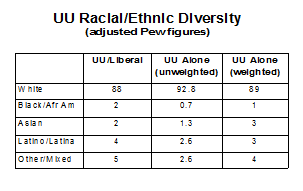
The first column is the one I showed earlier for “liberal faiths”; the other two columns use only the Unitarian Universalist responses. The unweighted percentages are based on the raw data alone; the weighted percentages are adjusted according to a complex formula that accounts for potential sampling errors. The Pew people prefer the weighted percentages, but both are statistically valid, so take your pick.
When we place the two surveys side by side after these adjustments, we get this:

(In the bar graph, I split the difference between the weighted and unweighted Pew numbers.) One obvious implication is that we weren’t quite as white in 1997 as we thought we were, though 91.5% is still pretty white. Another is that our diversity over the past decade has not fundamentally changed. Of course we can’t be sure of this based simply on two surveys taken a decade apart using very different methodologies. The experience in your congregation may be different. We could avoid these ambiguities by regularly collecting our own data.
Ministers and Theological Students
Fortunately, we have better information on our ministers and theological students. In fact, we have exact numbers rather than survey samples, and I want to thank John Weston and David Pettee of the UUA Ministry staff for sharing their data with me. I did not try to gather comparable data for prior years, but the trend in our professional ministry might be indicated by the differences between these two groups.

It seems likely that the percentage of Unitarian Universalist ministers of color will increase over the next decade as large numbers of current senior ministers, mostly white, retire. But we can’t take this for granted. We do not yet know how many of these students will actually become ministers, and placement of ministers of color in our congregations remains far too difficult. Of the 55 active Unitarian Universalist ministers of color today, only two-thirds, 38, are serving as parish ministers, and just 24 –less than half – are in senior or sole ministry positions. There are no MREs of color. As Mark Morrison-Reed and others have reminded us, the Unitarian Universalist parish ministry is a tough path for ministers of color to walk.19
The next chart shows the diversity of our active ministers and current theological students alongside Unitarian Universalists as a whole.

Notice that ministers are the least diverse; only one of the non-white groups is larger than 1%. Our students are slightly more diverse than our movement as a whole, and the percentage of multiracial students is much higher. This is in line with the overall demographic trend for young people, though of course we don’t know the ages of these students.
Children and Youth
Finally, I want to say a few words about our Unitarian Universalist children and youth. We have even less data about them than we have for our adult members, so I was not able to make any charts or tables. But we do know enough to make some useful observations.
When we look at the United States as a whole, we see that the multiracial and multicultural future toward which our society is rapidly moving is already here for our young people. A few quick facts: 44% of those under age 18 are minorities, and children are projected to be majority non-white by 2023, only 14 years from now.20 Among the so-called millennial generation, those born between 1980and 2000, one in five has at least one immigrant parent, and one in eight millennials were themselves born in other countries.21 Finally, more than half of all multi-racial persons in the United States are under age 20.22 This is the world of our Unitarian Universalist children and youth, whatever their individual identities.
It’s tempting to think that all we have to do is wait another generation and our vision of a multiracial-multicultural Unitarian Universalism will happen by itself. But that would be a mistake. It would not only be a religious and moral cop-out, a repudiation of the very work to which we have committed ourselves, it wouldn’t work.
Our less than adequate data suggest that most of our congregations have at least a few children and youth of color, including transracially adopted children.23 We know, or think we know, that our children and youth are more diverse than the rest of us – than those of us in this room, for example. But we also know, or think we know, that they are less diverse as a group than the U.S. population under age 18 as a whole. The Mosaic Project Report published earlier this year tells us that 42% of our Unitarian Universalist youth of color
are the only ones in their congregations’ youth groups, and another 44% are in groups that have only two or three. In other words, our Unitarian Universalist children and youth for the most part attend religious education classes and youth groups that are far less diverse than their school classrooms. Moreover, two-thirds of our youth groups have no adult supervisors of color. As a result, many of our youth of color experience the same isolation and lack of support felt by so many of our adults. The Mosaic Project concludes:
The Unitarian Universalist culture [our Youth and Young Adults of Color] experience may not be relevant to their life experiences. Even though many of [them] have been UUs from birth, feelings of being an outsider are prevalent. The vision of community promised by our seven Principles often fails them.24
This is a powerful indictment, and it is another reason the numbers matter. If we do not become the multiracial-multicultural faith we have called ourselves to become, we will not only have failed our children and youth of color, we will very likely lose them.
Before I leave the demographics, I thought it might be interesting, given our setting this year, to look briefly at racial diversity among Mormons.

Mormons are sometimes held up as the epitome of religious whiteness,25 but the Pew findings show that they are slightly more diverse than Unitarian Universalists. Something to ponder.
Theological Implications
I want to stand back from the numbers now and offer a few thoughts on their theological significance for Unitarian Universalism. In particular I want to ask: What theological resources do we have, and what theological challenges do we face, as we continue our journey toward becoming a multiracial-multicultural faith? I want to get at these questions by looking at two aspects of Unitarian Universalist theology that are especially relevant to this vision: its orientation toward modern culture and its impulse toward theological pluralism.
Cultural engagement
It is widely accepted among scholars that religious liberalism’s central defining characteristic is its posture of intentional engagement with modern culture.26 Liberal theology starts with the premise that religion should be oriented toward the present, taking fully into account modern knowledge and experience. As a result, Unitarian Universalists and other liberals are not likely to feel their faith threatened by new scientific discoveries or advances in biblical scholarship, for example. Rather than resist these kinds of developments, liberals tend to embrace them and incorporate them into their religious worldviews. As I noted earlier, this is how religious liberals have sought to keep their religious commitments culturally relevant and intellectually credible.
This posture of cultural engagement would seem to make Unitarian Universalists ideally situated to respond to the large-scale changes taking place in our culture – to become, in effect, the religion for our time. But it’s not that simple. The challenge of multiculturalism raises some difficult questions about the nature of our cultural orientation, and ultimately about our religious identity.
As religious liberals, we do not simply and uncritically absorb every feature of our culture. We oppose social and institutional structures that perpetuate injustice; we reject our society’s celebration of violence; we do our best to resist the lure of its pervasive materialism. Our cultural engagement is a critical engagement. This posture grounds our prophetic practice, encouraging us to live fully in the world while bringing our religious values to bear on it.
I want to suggest now that despite our activism, our primary mode of cultural engagement has been intellectual. In adapting to modern culture, Unitarian Universalism has for the most part adopted the core values of modernity, including its emphasis on human reason, the autonomous authority of the individual, and the critical evaluation of all religious truth claims.27 We want our religious beliefs and commitments to make sense, so we examine them and reexamine them, taking nothing for granted, and especially taking nothing on someone else’s say-so. These are important values, and we rightfully treasure them. Yet this legacy encourages us to keep our religious commitments largely in our heads, where we can hold them at a comfortable arm’s length. This gives us a sense of control; it allows us to feel spiritually safe.
Multiculturalism threatens this sense of safety. I have come to think that for many Unitarian Universalists, multiculturalism represents a form of danger. I do not think the danger, or the perception of danger, lies in the shifting demographics. In fact, I think most of us welcome this as far as it goes. Instead, the sense of danger points to a deeper fear. At one level it is the fear of change, and the fear of difference that change always represents. As I pointed out in Faith Without Certainty, the liberal emphasis on individual autonomy masks “a fear of otherness that we have barely begun to recognize.”28
At a deeper level, I think it is a fear of losing control. I am not talking here about political or social control, the fear perhaps that entrenched power groups in our congregations might lose their influence, though that might happen. Instead, I think the real fear is the loss of intellectual control. Our move toward becoming a multiracial and multicultural faith challenges our safe and tidy way of being religious. In this sense, multiculturalism might represent for some a threat not simply to our illusion of control, but to our very identity. Personally, I think our religious identity will be deepened, not destroyed, as we become increasingly multiracial and multicultural. I worry that our identity will be stunted by fear if we don’t.
The point is this: We cannot reason our way into multiculturalism. The reality of lived multiracial and multicultural communities cannot be grasped through analysis, statistical or otherwise. We will have to embrace it bodily, not just intellectually. We will have to wade into the new cultural waters up to our necks, and even risk getting in over our heads, without first being able to measure the currents or predict the storm cycles. In theological terms, our challenge is to embrace a new understanding of our cultural orientation.
Pluralism
Another feature of our faith tradition that should make us ideally situated to respond to the new cultural context is our inherent theological pluralism. This pluralism is a product of our commitment to free religious inquiry and our openness to insight from many sources, including other religious traditions. While we sometimes lose patience with each other and occasionally bite our tongues, on the whole Unitarian Universalists have learned to live comfortably with and even to celebrate our internal diversity. At its best it is mutually enriching and helps create an atmosphere of welcoming and invitation in our congregations.
Yet our comfort with diversity has its limits. Because we want our theological differences to be non-threatening, we tend to avoid discussing them too vigorously, or proclaiming our own beliefs with too much conviction, for fear of excluding or disrespecting otherviews.29 The result, once again, is that many Unitarian Universalists have unwittingly adopted a kind of theological “don’t ask, don’t tell” policy. Out of fear of saying something that might offend someone, we can easily end up saying nothing.
Like our cultural adaptation, our theological diversity can be kept safely in the intellectual realm. We tend to see it as an expression of freedom of conscience and individual autonomy, the natural byproduct of a creedless faith. But multiculturalism involves a different kind of pluralism. Our challenge is to transform our pluralism of ideas into a pluralism of being.
But how do we do this? What theological resources do we have that might address these concerns and ground us on this journey? I want to close by offering an insight from our Universalist heritage that might be helpful.
Universalism’s core theological claim is that all humanity –indeed all of creation – is ultimately united in a common destiny. This was the meaning of its original doctrine of universal salvation. In contrast to the Calvinist doctrine of election, in which only a few of us – the “elect” – would be saved, Universalists held that all would be saved. Universalist theology refused to divide the world into factions or to exclude anyone from its vision. It said we’re all in this together, and wherever we are headed, we will all share in it.
Early Universalism was a communal faith. “Communal” here means more than a group of individuals who share a common belief and come together for mutual support and worship, the way we might understand it today. Instead, in this form of communal theology, the individual was removed from the religious equation. Universalists insisted that our personal salvation was no more important than anyone else’s salvation. As Ann Lee Bressler puts it, Universalism “encouraged the believer to think of his own interests as inseparably linked with the eternal welfare of the whole of humanity.”30
This theological core led to a radical egalitarianism. The American emphasis, shared by most Protestant denominations, including Unitarians, had always been on equality of opportunity, at least in principle, while in practice tolerating vast inequalities of outcome. But Universalism’s egalitarian theological doctrine became the basis for a truly egalitarian social doctrine – “an egalitarianism not of opportunity, but of desert”31or outcome. In other words, Universalism was not simply pluralistic; it was radically inclusive.
There is something theologically vital in the original Universalist insight, something that might help us embrace multiculturalism as part of a radically welcoming, radically inclusive religious identity. If we restate this Universalist principle in the language of our own time, we might say that it is basically a commitment to liberation. And liberation has always been a central theme in Unitarian Universalism. James Luther Adams spoke of this a half century ago when he noted that liberalism’s “characteristic feature” is:
the conviction that human beings should be liberated, indeed should liberate themselves, from the shackles that impede religious, political, and economic freedom and which impede the appearance of a rational and voluntary piety and of equality and justice for all.32
Early Universalists understood – as did Adams – that liberation is communal, that human fulfillment and liberation are possible only in a context of open and inclusive communities based on respect and justice. Liberal theology today, like early Universalist theology, recognizes that spiritual liberation and social liberation are inextricably linked.
Our commitment to creating a genuinely multiracial-multicultural Unitarian Universalism has deep roots. It is grounded theologically not only in our current Principles and Purposes, but ultimately in the early Universalist theology of radical egalitarianism, a theology lived out in radically inclusive religious communities and congregations. Our shifting cultural context is both a challenge and an invitation to reclaim this vision and make it a reality in our time.
Thank you.
- Quoted in Charles A. Howe, The Larger Faith: A Short History of American Universalism (Boston: Skinner House, 1993), 96.
- Mark D. Morrison-Reed, Black Pioneers in a White Denomination (Boston: Beacon Press, 1984), 177.
- U.S. Census Bureau release, August 14, 2008, http://www.census.gov/Press-Release/www/releases/archives/population/012496.html; detailed tables at http://www.census.gov/population/www/projections/tablesandcharts/table_4.xls.
- U.S. Census Bureau release, May 14, 2009, http://www.census.gov/Press-Release/www/releases/archives/population/013733.html; Hope Yen, “Multiracial People Become Fastest-Growing US Group,” Associated Press (May 28, 2009), http://hosted.ap.org/dynamic/stories/U/US_MULTIRACIAL_AMERICANS?SITE=MAFIT&SECTION=HOME&TEMPLATE=DEFAULT.
- Michael W. Foley and Dean R. Hoge, Religion and the New Immigrants: How Faith Communities Form Our Newest Citizens (New York: Oxford University Press, 2007), 57-58.
- Foley and Hoge, Religion and the New Immigrants, 58.
- Pew Forum on Religion & Public Life, U.S. Religious Landscape Survey (2008),Appendix 1.
- Journey Toward Wholeness, ii.
- Taquiena Boston, Preparing for Multicultural Ministries, workshop #3021, presented at General Assembly 2008; excerpt available at http://www.uua.org/aboutus/professionalstaff/identity-basedministries/racialand/diversityministry/116006.shtml.
- William G. Sinkford, address to the Unitarian Universalist General Assembly, Fort Worth, TX (June 2005), quoted at http://www.uua.org/leaders/leaderslibrary/araomc/index.shtml.
- See Anita Farber-Robertson, “Toward a Theology of Anti-Racism,” in Journey Toward Wholeness (Unitarian Universalist Association, 1996): 39-42.
- Joseph M. Santos-Lyons, 25 to 1: People of Color Experiences in Unitarian Universalism 1980-2995 (Harvard Divinity School, 2006), at 5, 49-53.
- Mark Morrison-Reed, In Between: Memoir of an Integration Baby (Boston: Skinner House, 2009), 239.
- See Journey Toward Wholeness, 59.
- Rev. Dr. Marilyn Sewell, “Repression of the Sublime,” in UU World, Fall 2005, available at http://www.uuworld.org/spirit/articles/1837.shtml.
- Fulfilling the Promise (Unitarian Universalist Association, 1998), 44-49. Survey results are also available at http://www.uua.org/leaders/leaderslibrary/demographics/130035.shtml.
- Pew Forum on Religion and Public Life, U.S. Religious Landscape Survey (February 2008), http://religions.pewforum.org/; race and ethnicity data available at http://religions.pewforum.org/pdf/table-ethnicity-by-tradition.pdf.
- Email from Allison Pond, Research Associate at the Pew Forum on Religion & Public Life, May 29, 2009.
- Mark Morrison-Reed, In Between: Memoir of an Integration Baby (Boston: Skinner House, 2009), 196-228; see Santos-Lyons, 25 to 1, at p. 66. The UUA Diversity of Ministry Initiative is working to address this; see http://www.uua.org/aboutus/professionalstaff/identity-basedministries/racialand/diversityministry/index.shtml.
- Census Bureau release, August 14, 2008.
- Laura W. Spencer, Mosaic Project Report: An Assessment of Unitarian Universalist Ministry to Youth and Young Adults of Color and Latina/o and Hispanic and Multiracial/Multiethnic Descent (Boston: Unitarian Universalist Association, 2009), 10.
- Hope Yen, “Hispanic Enrollment in Schools, Colleges Rising,” Associated Press, March 5, 2009.
- Mosaic Project Report, 35.
- Mosaic Project Report, 48.
- See Hua Hsu, “The End of White America?” The Atlantic (January-February 2009):46-55, at p. 52, referring to “the deliberately white-bread world of Mormon America, where the ’50s never ended.”
- William R. Hutchison, The Modernist Impulse in American Protestantism (New York: Oxford University Press, 1976), 2. See Paul Rasor, Faith Without Certainty: Liberal Theology in the 21st Century (Boston: Skinner House, 2005), 11-15.
- Rasor, Faith Without Certainty, 34-41.
- Rasor, Faith Without Certainty, 127.
- See Christopher Hinkle, “Pluralism’s Problematic Appeal for Religious Liberals,” paper delivered at the American Academy of Religion, November 2007.
- Ann Lee Bressler, The Universalist Movement in America, 1770-1880 (New York: Oxford University Press, 2001), 35.
- Bressler, Universalist Movement, 37.
- James Luther Adams, “The Liberal Christian Looks at Himself,” [1956] reprinted as “The Liberal Christian Holds Up the Mirror, “in James Luther Adams, An Examined Faith: Social Context and Religious Commitment George K. Beach, ed. (Boston: Beacon, 1991):308-322, 311-312.