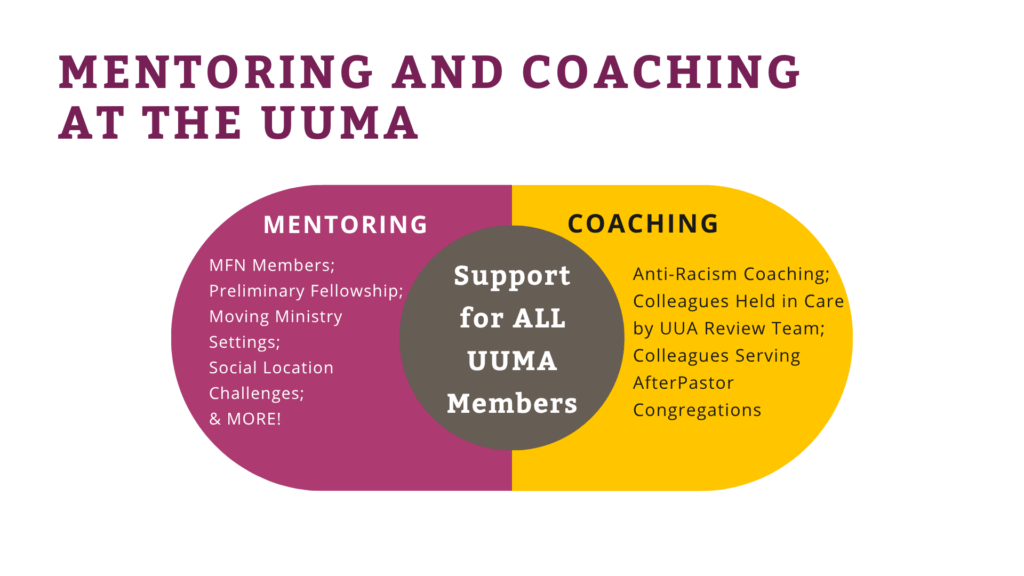
Support for All:
Mentoring & Coaching at the UUMA
“The religious way is the way that touches universal relationships;
that goes high, wide and deep, that expands the feelings of kinship.”
– Sophia Lyons Fahs, religious educator and minister
About Mentoring and Coaching
The Flourishing in Ministry project identifies supportive relationships with significant others, similar others and supportive and resourcing others as essential to health and wellness throughout a life in ministry. Mentoring and coaching are two of three such supportive relationships that we here at the UUMA are glad to support. (The third type is Good Offices.)
Traditionally, mentoring is seen as a transmission of knowledge and experience from a more experienced colleague to a newer colleague, while coaching (as a newer form of support in our collegial and Western culture(s)) has as many definitions as there are schools to learn it. We recognize that the line between these can be blurry, as mentors often use coaching skills.
For our purposes at the UUMA, we define mentorship as an integral part of our lifelong ministerial formation and growth, and we encourage our members to see mentoring as a lifelong process. Ideally, we are all mentoring and being mentored all the time. A younger colleague who is newer to ministry might be the perfect mentor for someone who has lost the spark of their call, or is struggling to learn a new way of doing ministry. In this model of mentorship, we all take turns holding a supportive environment for each other.
We encourage each other to seek a mentor when:
- We are first discerning our calls and engaging in the ministerial formation process*
- When the Ministerial Fellowship Committee (MFC) offers counsel or a contingency and requires coaching/mentoring
- We are welcomed into preliminary fellowship and take up our first ministries. (required for renewals)
- We change ministry contexts throughout our careers and find ourselves beginning again (new community ministry context, or community/parish switch)
- Our social location makes our ministry harder and we benefit from the support of someone who has been there, done that
- We need support while achieving an educational goal (board certification, DMin)
- We change in significant ways or when we encounter new challenges and need help imagining and practicing new ways of approaching ministry. For example, these changes might include:
- a change in life patterns/family (divorce, having a child);
- navigating a new disability;
- change in size or type of parish ministry; or
- encountering a new challenge at our current ministerial setting
- We are preparing to move into elderhood
*As we broaden the scope of our mentoring program our MFN Vocational Advisors will now be referred to as a MFN Mentors.
Coaching at the UUMA is utilized for specific situations that require more specialized knowledge or skills. Currently we offer three kinds of coaching for members:
- Anti-Racism Coaching (by and for white colleagues*)
- Coaching for colleagues being held in care by the UUA Review Team, after a conflicted ending in parish ministry
- Coaching for colleagues who have recently discovered their parish setting is an after-pastor congregation
*Our intention is to expand this offering to also offer anti-racism coaching for and by BIPOC colleagues, and also to attend to other forms of oppression. Coming soon to a UUMA near you!