
Institute Home * Program Overview * Registration * Schedule * Housing
Institute Learning Tracks
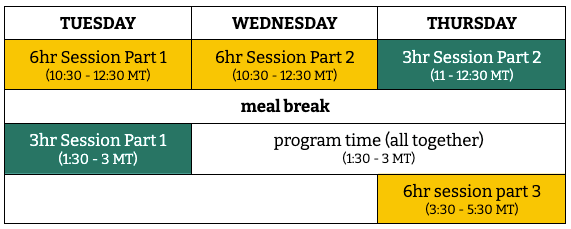
Over the course of our week together, we will have 9 hours dedicated to learning time. Below is a list of the different options you can choose from; please note that some of these will overlap and you will need to prioritize your learning needs. For example, you can take a 3-hr track and a 6-hr track, but not two 3-hr tracks as they meet at the same time. If you select a 9-hr learning track, you be using all of the learning time for that one track.
If you are attending onsite you are welcome to select a virtual option but will need to supply your own technology for attending the learning track you select.
We have now added learning track selection to your registration. If you have already registered you can add your selection(s) here but if you haven’t registered please use the fields on the registration form to indicate your preference! Questions about your registration and learning track selection(s) can be sent to our registrar.
VIRTUAL OPTIONS
The Congregational Journey to Accessibility, 3 hrs – Gretchen Maune and Molly Housh Gordon
How can a congregation focus on accessibility when there are so many other issues to tackle? How can Coffee Hour be more accessible? Can using accessible and inclusive language in worship be more like writing poetry? How do we ground our pastoral care work in disability justice? UUA Accessibility Specialist Gretchen Maune and the Rev. Dr. Molly Housh Gordon will share learnings from their decade working together to make the UU Church of Columbia, MO ever more accessible and inclusive.
Lightening the Lift: Reducing Friction in Team Dynamics, 3 hrs – Leela Sinha
How do we keep from burning out our lay leaders? How do we make sure we hire the people we need on staff, especially given fiscal constraints and shrinking staff sizes? How do we build staff and lay teams that appreciate each other, rather than ending up in conflict over personality issues? Effective, energetic and enjoyable collaboration is possible. (And what effectiveness, joy and energy look like depends on who you are!) This introductory workshop will give you a model for recognizing and addressing strengths and needs in your human systems. We can do a better job of caring for each other, creating supportive environments and processes that make our work easier and more joyful. Join us to learn more.
Dinner Church Discernment and Design, 3 hrs – Aisha Ansano and Emily Conger
This workshop invites participants into a discernment process to design embodied ministry experiences to meet the needs of their communities and contexts. Together, we will explore questions such as, What is dinner church? What are best practices? How can you meet the needs of your community creatively? We will explore ritual elements and tools for implementing embodied, multi-generational, meal-based worship.
Preparing for Your Sabbatical, 3 hrs – Darcey Laine
Rest is resistance. Even (especially) in these challenging times, religious professionals and the communities they serve need sabbath time to rest, renew and re-inspire their calling. There is no one size fits all sabbatical — some folks like to travel, but others need to stay close to home where family needs their care. Some professionals have paid time off, others self-fund their sabbatical leave. Some have ambitious goals for study, writing, community service or artistic projects, others need time to heal grief and burnout. To allow the sabbatical to do its work on our bodies, minds, hearts and spirits, taking time to discern our sabbatical path is vital.
This workshop will be a balance of discerning what your body, mind and spirit most need from a sabbatical, with time for your nuts and bolts questions about how to make it work in your context. A balance of individual discernment, reflecting together and creating a network of care with colleagues embarking on the sabbatical journey.
Feedback Beyond Blame and Shame, 6 hrs – Aisha Hauser and Pam Orbach
Do you dread giving feedback to staff or colleagues? No matter how careful you try to be in feedback, does it land as criticism, or result in defensiveness from the other person so you regret even telling them? We all have varying relationships to the experience of giving and receiving feedback. At its best, feedback can be a gift, an investment in a relationship or collaboration. And yet, it is not always given or received as such.
This training helps to take blame and shame out of feedback. We will offer a step-by-step process that leads to a different experience, one that prioritizes connection and learning. The training will allow participants to bring more specificity, compassion, and creativity to feedback conversations, thereby supporting the growth and other needs of those involved.
Rooted and Rising: Embodied Paths Toward Collective Liberation, 6 hrs – Arran Morton and Karen Fraser Gitlitz
In this program we learn embodied practices that sustain spiritual grounding and provide individual and community resources for the long haul. We explore skills that help us build relationships and support a practice community for collective liberation. The program draws from politicized somatics, active mindfulness, art, ritual, and group sharing.
Slow Ministry: Toward Greater Sustainability in our Ministries, 6 hrs – Florence Caplow
Many of us have heard of the Slow Food movement, but we may be less familiar with Slow Ministry. Slow Ministry is a re-visioning of ministry intended as a path toward long-term sustainability for the minister and greater health in the system (especially in this time of ministerial burn-out and heightened reactiveness in congregations and other work settings) and a recognition that the pace of white supremacy culture can lead to a loss of health, spiritual depth, and capacity in ministers and other leaders. Slow Ministry emphasizes care of the body, spirit, and family; skillfulness in our time management; intentional rest and sabbath; and allowing other leaders to co-lead with us. Slow Ministry recognizes that bigger is not always better. Slow Ministry is a process and practice, not a goal.
In this interactive program we will explore the nature of Slow Ministry, individual and institutional barriers to slowing our ministry, why our own health and well-being and the health of the systems we work within are intertwined, how we can take small steps toward more life-giving work patterns, and how we might communicate with supervisors, boards, and leaders to gain their support. We will have times of contemplative writing, small group listening, creative activities, and sharing of poetry and inspirational writings, but the program itself will be “slow”, with plenty of spacious time.
This program would be appropriate for ministers interested in learning more about this approach and how to integrate it into their current work position, those who are experiencing the negative effects of overwork and over-functioning, ministers with new or ongoing health challenges, and those newer to ministry or to a new ministry setting who would like to “try something different this time.”
RE Sea Change, 9 hrs – Wren Bellavance-Grace & colleagues
You may have heard curriculum isn’t “working” in faith formation. The reality is much more nuanced. Yes and no and everything in between. What does “thriving” look like for your families, children, and youth? What does “thriving” look like in your religious education and faith formation ministry? In the past two years, UUA staff have been hosting ongoing conversations about emergent faith formation, the role of structured programming, the stresses our families are under, children/youth needs now, and the wide spectrum of responses congregations have. Many LREDA members have been part of these conversations; this workshop is an intentional opportunity to bring clergy into this conversation. In this workshop we will explore the shifts in Religious Education and facilitate the creation of congregational size based cohorts. Together we will learn and discuss what’s emerging, the clergy and religious educator role, mission alignment, and what’s working and thriving.
Innovations and Challenges in Chaplaincy, 9 hrs – Karen Hutt & Colleagues
The Board of Chaplaincy Certification Inc (BCCI) offers 8 different types of methodologies for their continuing education standards. When you register for the UUMA Institute and select the Innovation and Challenges in Chaplaincy learning track, you will be able to count:
- 5 hrs toward the “research” methodology (#8), because you will have the opportunity to collaborate in a focus group research conversation on current best practices to support institutional change in your ministerial setting;
- 4 hrs toward the “attending educational events” methodology (#1), because the learning track is 9 hrs, so this completes the learning time; and
- 4 hrs toward the “professional self care” methodology (#4), as there will be plenty of opportunities to create a space for “spiritual retreat” and reinvigorate your ministerial call. (You could probably count more, but 4 hrs is the maximum allowed!).
Our beloved colleague Karen Hutt is looking forward to hosting the Innovations and Challenges in Chaplaincy track, which will meet online for a total of 9 learning hours, over the course of three days. When you register for this track, this will give you the opportunity to help Karen fine-tune your learning experience – we will be sending a follow up survey to all who register for this track to identify your specific learning needs.
We are looking forward to offering an excellent learning experience that combines time in a focus group (with a potential for future collaboration in publication), thoughtful conversation about chaplaincy in a time of polycrisis, and valuable time away from your daily grind to take stock of your strengths and identify areas of opportunity in your chaplaincy setting. Join us!
ON SITE OPTIONS
Trauma Informed Ministry in Troubled Times, 6 hrs – Elizabeth Stevens and Leslie Takahashi
Between climate change, the epidemic of gun violence, and the assault on our values in the public square, we are living in a time of unprecedented stress and trauma. Understanding the impact of trauma on our body, mind, and spirit can help us stay sane and continue to serve with compassion and grace. This interactive program will offer better understanding and a bigger tool kit for religious professionals. Each session, we will ground ourselves with trauma-sensitive spiritual practice or ritual. Then we’ll explore trauma and practices of resilience through cognitive, physiological, and theological lenses.
The Landscape of Grief, 6 hrs – Tania Marquez
How does grief impact the individual? What is the role of community in grief work? This 6 hr workshop offers a compassionate space to explore and understand the different dimensions of grief and its impact on the individual. Through reflection, embodied practices, and shared ritual, participants will deepen their understanding of grief.
Ministry to Meet the Moment, 9 hrs – Ashley Horan other UUA leaders
Grounded in the UUA’s emerging Meet the Moment framework, which will be showcased at GA 2025 and rolled out broadly for use across the Association in 2025-2026, this track will offer both new and experienced religious professionals an opportunity to explore what nimble, skilled, grounded ministry looks like within the current global, religious, and political landscape. Led by senior UUA Leadership who are deeply engaged with supporting and leading strategic, values-rooted responses to these times, this track will use a variety of modalities (panel dialogues, abbreviated worship and embodied practices, small group conversations and play, practical skill building and analysis) to engage participants in developing shared understanding of the ministry context we are navigating, the most urgent needs and opportunities for religious professionals in these times, and how our values compel us to show up with both impact and integrity in this moment. Specific skills and topics will include:
- Risk assessment and management
- Community partnerships & organizing strategy
- Pastoral care & spiritual nourishment in times of sustained crisis
- Narrative, storying, and prophetic communications
- Strategy planning & institution building in uncertain times
All participants will be given resources and templates to engage their congregations and communities in Meet the Moment conversations at home. Participants will also have the optional opportunity to self-organize into praxis groups (Wave Cohorts) beyond UUMA Institute, with baseline support and resources from UUA staff.
Good News: Preaching with Power, 9 hrs – Sadie Lansdale, Matthew Johnson and Verdis LaVar Robinson
How, in this time, can our preaching be water for parched souls? Are we preaching with or preaching at? Together, we’ll explore how, grounded in our theology and practice, centered in story and with living liturgy, our preaching can be more alive and useful. Despite it all, there is Good News for our people in this time: Hope that’s not cheap, joy more powerful than prediction. Come hungry, leave fed and ready.
Performing a Liberation Theology of Improv, 9 hrs – Darrick Jackson
This interactive workshop will introduce participants to Darrick’s liberation theology of improv. We will engage in improv exercises while reflecting on how they can theologically ground us and build skills for collective liberation.
When Misconduct Happens: A Systemic Exploration, 9 hrs – Sunshine Jeremiah Wolfe and Samantha Wilson
This program provides a holistic approach to understanding how misconduct occurs, how to respond to it, and how to help congregations and communities recover. Recognizing that we are still figuring out how best to respond, participants will be given information on what we do know and what has worked, then they will be asked to engage creatively on tools for prevention and resilience. We will spend time exploring the conditions that bring about misconduct, the impacts and responses, and what it takes to help congregations and communities thrive afterward.
Program Overview * Registration * Schedule * Housing * Learning Track Selection